In this project, make four of the five Platonic solids—cube, tetrahedron, octahedron, and icosahedron. The tetrahedron and cube are easy to make, while the icosahedron can be hard for children under ten. Make the tetrahedron before trying to make either of the other two solids with triangular faces.
These geometric models can be used for things beyond learning about solid geometry. Decorate them and make a colorful mobile with a paper plate and some string. Use them as Christmas tree decorations, or use one as a gift box and put a small present inside.
Tip: Learn more about Geometric Solids below.
Related craft: For another way to make geometric solids, see the Platonic Solids craft project. Believe it or not, each solid is made from circles!


Choose the geometric solid you want to make! There are templates for
a cube, a tetrahedron, an octahedron and an icosahedron. Download and print the pattern.
Choose a design that prints in color, select a black & white
pattern to print on colored cardstock, or use your
creativity to decorate the solid.
Patterns are Adobe PDF files. The Adobe Reader is available for free.
All of Aunt Annie's project patterns are designed to be printed on standard letter-size paper (8.5"x11" or A4). When printing from Adobe Reader, you may need to select Auto-Rotate and Center or Choose paper source by PDF page size to ensure the best fit.
Color the pattern template as you like with markers, colored pencils or crayons. You don't need to color the glue tabs.
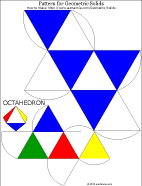
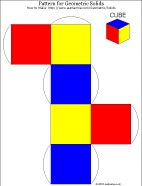
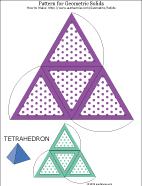
Cut around the polyhedron's pattern on the outline. Try to make your cuts very straight and smooth. There will be one piece, ready to fold, after you cut. (The octahedron pattern and tetrahedron pattern have two templates—small and large.)
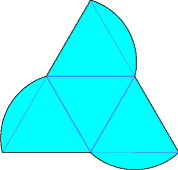
Scoring the fold lines makes for easier folding and sharper creases. The fold lines are marked in blue on the illustration.
To score: Turn the template with the printed/decorated side up. Use a ruler and the empty ballpoint pen (or bone folder) to make an indent along the fold lines.
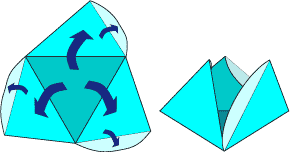
With the printed side down, fold each line that has been scored.
Be sure that all folds are sharp.
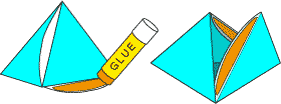
Gently form the solid into its shape, referring to the illustration on the pattern. Carefully glue each tab into place. The tabs can be glued on the outside where the sides meet, or on the inside. It is much easier to glue the tabs on the outside, but the solid will look neater with the tabs glued on the inside.
That's it! Your geometric solids
are complete!
Geometric solids are three-dimensional objects like spheres, cones, and cubes. Solids with only flat surfaces and straight lines are known as polyhedra. There are many different polyhedra, but five of them have the property of being "regular". A solid is regular if all of its faces are the same, and the same number of planes (faces) meet at each corner (vertex). Five solids qualify as regular (also known as Platonic)—three are based on triangles (tetrahedron, octahedron, and icosahedron), one is based on squares (cube), and one is based on regular pentagons (dodecahedron).
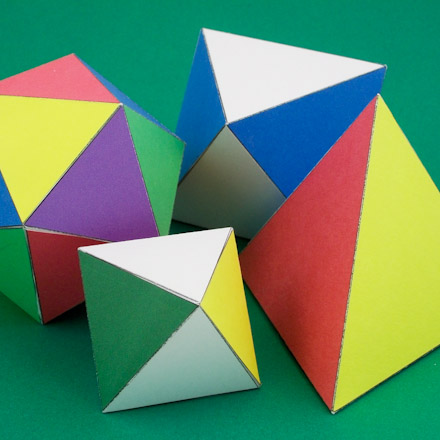
Three of the solids in this project are based on equilateral triangles. The tetrahedron has four sides (or faces), while the octahedron has eight and the icosahedron has twenty. The tetrahedron has three triangles that meet at each corner (or vertex). Four triangles meet at each corner of an octahedron, and five triangles meet at each corner of an icosahedron. Examine your models to see these properties.

Tip: The octahedron patterns include two sizes. (So do the tetrahedron patterns.) Glue tabs can be glued inside for a neat look.

Tip: This tetrahedron has the glue tabs glued on the outside for a different look. This is a much easier way to glue the solid models.

Project Extra: For a cute set of solids or a gift box, print these Pastel Polka Dot digital papers on cardstock with the solid's pattern on the reverse side.
Tip: The polka digital papers are printed on pastel cardstock to make these gift boxes. Holes are punched and laced with ribbon, then the gift boxes tied closed.

Tip: The solids made with the dotted patterns are cute and clearly show the triangular faces.

Tip: The colored icosahedron model has five colors that meet at each vertex. The cube has three colors meeting at each corner.