
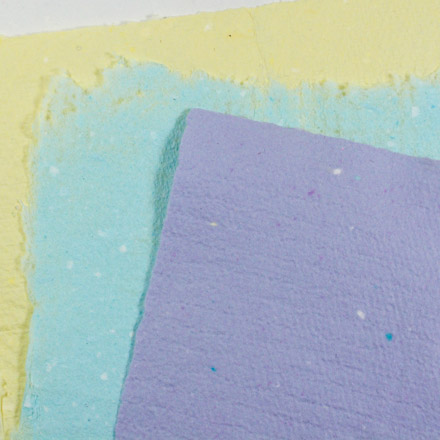
Here’s a fun and easy way to recycle those piles of paper spewed from your printer and have fun with the kids at the same time. With simple equipment and lots of water, you can turn that leftover paper into elegant handmade paper.
In this project, you will learn how to make paper by hand from recycled
scraps of paper. Learn techniques that will give the best results at home, along
with simple and inexpensive alternatives for children or beginners who just want to experiment.
Regardless of equipment or technique, there are three basic steps in papermaking:
• Prepare material (pulp)
• Mold pulp into a sheet
• Dry sheet
The resulting paper can be used as writing paper, to make elegant greeting cards, to make or line envelopes, to wrap gifts, to make gift bags, in collages and scrapbooking, or in any craft that can be enhanced by wonderfully textured paper.
Related craft: Make a Mold and Deckle, an essential tool for handmade papermaking.


Before you start making paper, you will need to prepare your equipment and work area. Review the list above, and make sure you have everything needed to make paper.
Papermaking requires an area where water can be splashed around. Find a place where you can lay your mold and deckle, plastic tub, and boards with felts side-by-side. Cover the work surface and floor with plastic as needed, and set up the equipment.


Paper is made from a slurry of paper pulp. You will use the blender to break down the scrap paper into pulp fibers. Longer fibers will make stronger paper, so it is best to pre-soak the paper and blend it as little as possible. Children must be supervised when using the blender.
The sheet of paper will be formed on the paper mold and deckle by dipping them into the pulp slurry. It is important to develop a smooth motion in order to make sheets with a uniform thickness.

Now we will transfer the wet sheet from the mold onto the felt (or paper towel). This is known as couching.

The paper can be board dried or air-dried. I prefer board-drying, as it produces a flatter sheet of paper and drying is quicker.

Now, use your handmade paper in other crafts, in gift wrapping, or as elegant stationery.
That's it! You have made
your first handmade paper!

Tip: Give your paper added interest by adding snips of thread, bits of ribbon, parsley or chili pepper flakes, or flower petals to the pulp slurry in the tub.

Tip: For handmade paper with a smooth surface, dry it on a board. For a textured surface, dry paper on paper towels, cloth, or any rough surface.

