
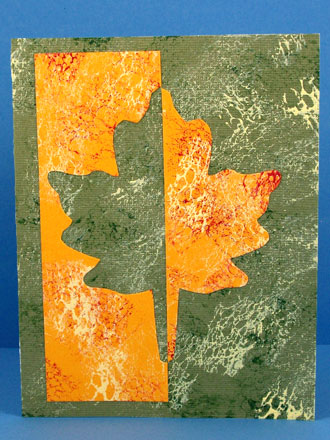
This greeting card tutorial uses sponged paper and leaf silhouettes to make a simple and elegant card. (Heart, butterfly and shamrock silhouettes are also included.) The design concepts of positive and negative space are introduced in this tutorial, along with how to make your own unique decorative paper by sponging with paint.
This greeting card tutorial builds on previous tutorials, especially #1: Four Patch Cards, #4: Stenciled Cards and #8 Bookmark Cards. If you are new to card-making or sponging with paint, review these tutorials before starting this one.
Related cards: St. Patrick's Day shamrock silhouette cards and Heart Silhouette Cards for Valentine's Day.
Refer to Tutorial #1: Four Patch Cards for how to make card blanks and envelopes.


Select colored cardstock for your card blank and a contrasting color of cardstock or heavy paper for the leaf silhouette. Natural colors will work best—green, yellow, orange, red, and brown. A medium-tone green card blank and bright yellow cardstock are used in the sample card.
For sponging, choose paint colors that coordinate with both cardstock colors. For the card blank, choose a darker or lighter shade of the card's color along with a light, neutral color. The sample card uses dark green and pale yellow. For the leaf silhouette, select two coordinating colors—a dark and a light—that will enhance the leaf. In the sample card, a dark burgundy red and pale yellow are used.
Tip: For color combination ideas, refer to the color wheel concepts in #6: Paper Weaving Card.
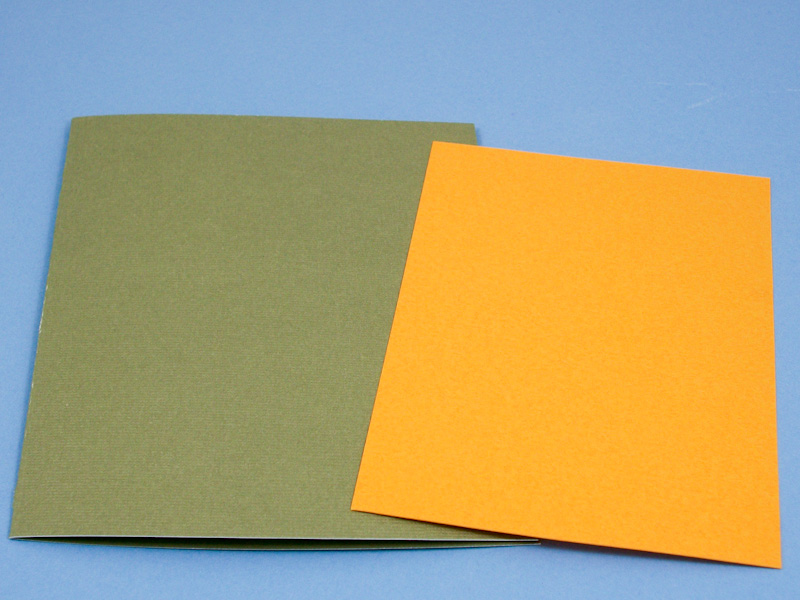
For the card blank, cut a full sheet of letter-size cardstock in half to make two 8½" by 5½" card blanks. Fold the card blank in half to make a 4¼" by 5½" card.
For the leaf silhouette, cut a 3½" by 5" or 3¾" by 5" rectangle from colored cardstock or heavy paper.

Fold the small rectangle in half and cut half of a leaf design along the folded edge. Drawing the leaf shape with a pencil as a guide for cutting may be helpful; or, cut and trace a template from this printable page of leaf shapes.
Unfold the silhouette cutout and the silhouette's rectangle, now with a leaf-shaped opening. In artistic terminology, the leaf cutout would be called a positive space, and the rectangle would be said to feature a negative space leaf. A good design will balance both negative and positive space.
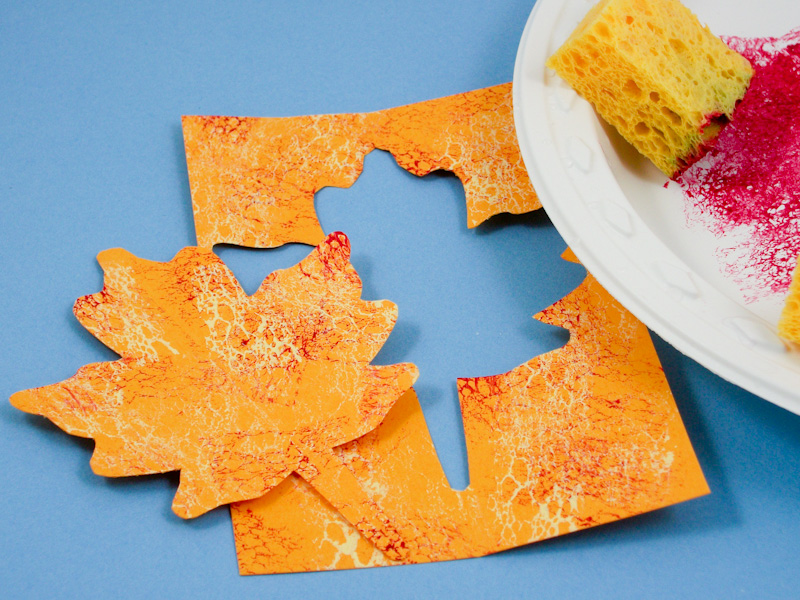
Sponge the card front using the two colors of paint you selected. Lightly sponge the card with an almost-dry sponge, applying the darker color and then the lighter color. Follow the instructions in #4: Stenciled Cards for sponging paint.
Lightly sponge the leaf cutout and rectangle with the two colors of paint you selected. A mottled look can be achieved by dabbing gently with an almost dry sponge.
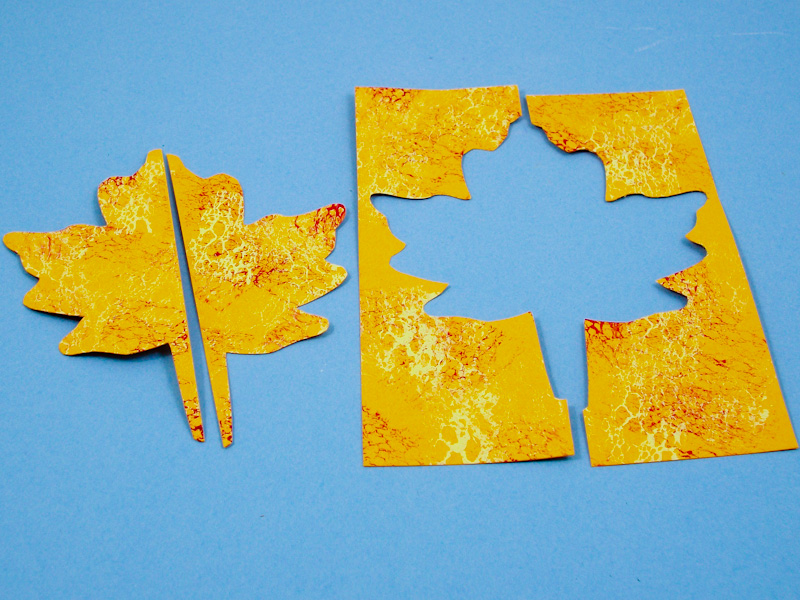
Cut the leaf silhouette and the leaf rectangle in half on the fold line. This creates two positive leaf shapes and two negative leaf shapes. Use one of each on the card front to create a balanced and elegant design.
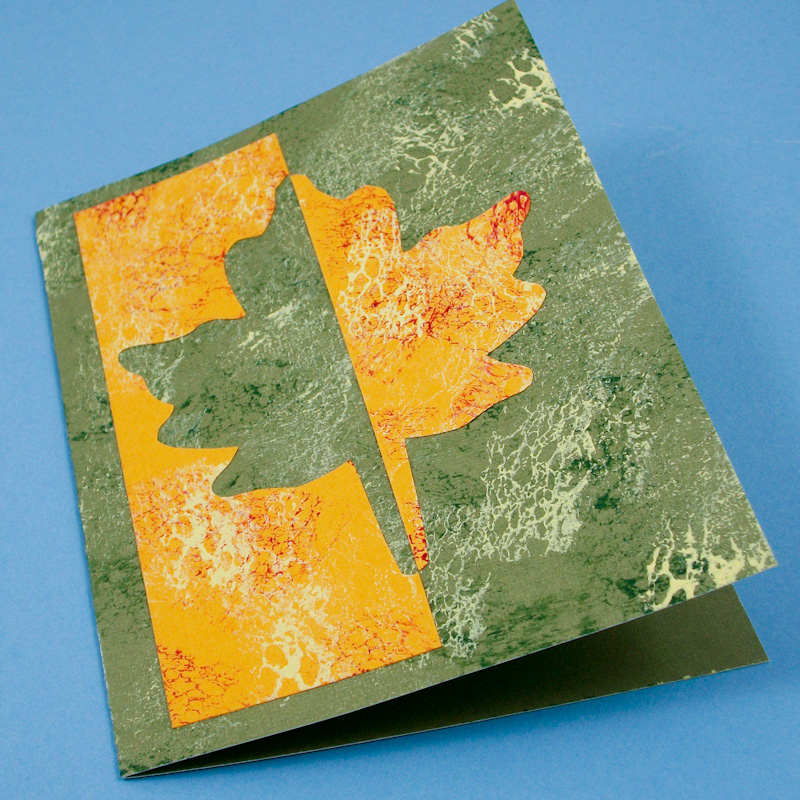
Center a positive leaf shape and a negative leaf shape side-by-side on the card front, and glue. The leftover shapes may be used to create another card.
Add a message to the inside of the card using black and colored markers, or glue a printed verse that is matted in a coordinating color of cardstock.
That's it! Your card is complete.
What other silhouettes might you use?
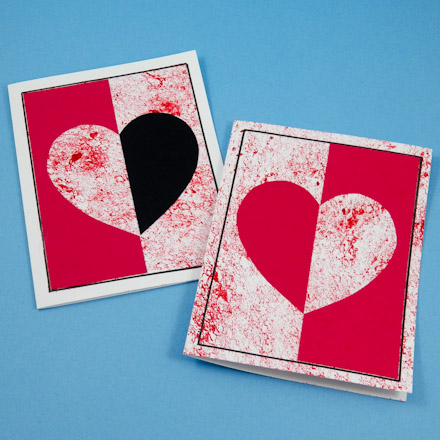
How about a heart?
Or a shamrock?
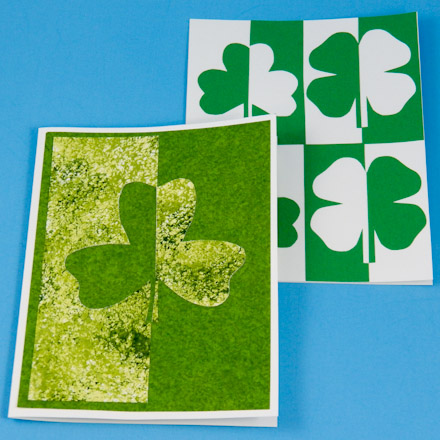

Tip: Two cards can be made from one silhouette cut.
Project Extras

Tip: Cut leaf shapes freehand or use this printable pattern with aspen, maple, oak and sweet gum leaf templates in three sizes. Use the larger size for one leaf on a card, medium for two leaves, and small templates for four leaves. See smaller leaf examples below.
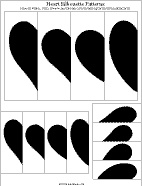
Use this printable pattern with four styles of heart templates in three sizes to make Heart Silhouette Cards.

Want more? How about some shamrocks?
Use the printable shamrock pattern to make St. Patrick's Day silhouette cards.

Try some butterflies!

Use this printable pattern with four styles of butterfly templates in three sizes to make another kind of silhouette card.

Tip: Use two smaller silhouette cuts to decorate a card. These leaf silhouettes were cut from 2½" by 3½" rectangles.

Tip: Four small silhouette cuts also work nicely to fill a card front. These leaf silhouettes were cut from 2 1/8" by 2 3/4" rectangles.

Tip: To create a plain border on your card, mask a ¼" border on all sides before sponging the card. Also, instead of sponging the silhouette, add details with a marker.

